

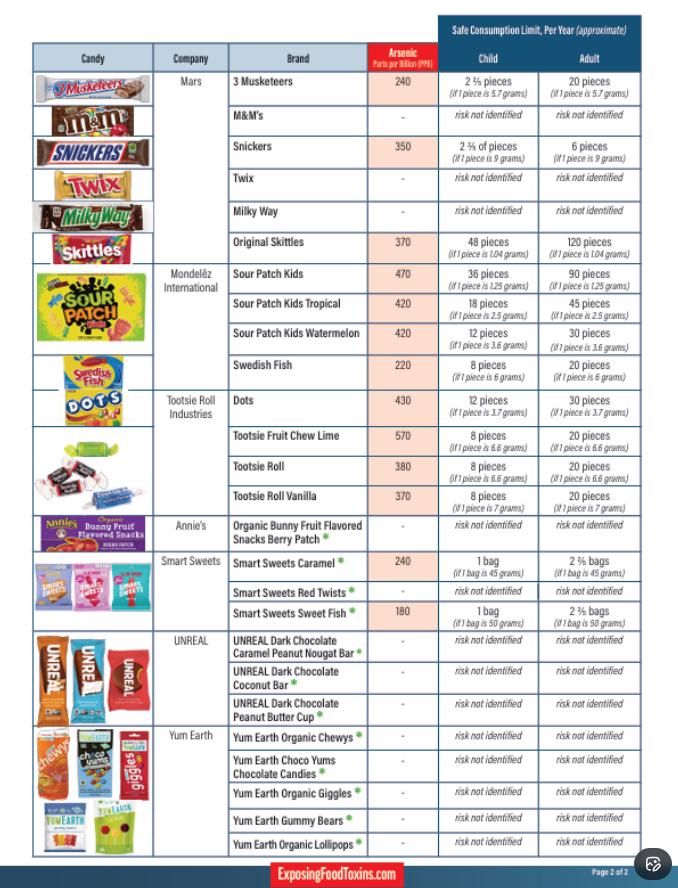
Today, I joined Fox & Friends to discuss the Healthy Florida First initiative. Parents deserve transparency and accountability when it comes to what’s in our food—especially what our children consume. Recent testing found elevated levels of arsenic in popular candies, in some cases exceeding what a child should be exposed to in an entire year in a single serving. Visit exposingfoodtoxins.com to learn more.
Today, I joined Fox & Friends to discuss the Healthy Florida First initiative.
Parents deserve transparency and accountability when it comes to what’s in our food—especially what our children consume. Recent testing found elevated levels of arsenic in popular candies, in some… pic.twitter.com/YEh4mU5hUO
— Casey DeSantis (@CaseyDeSantis) January 27, 2026
ALERT everyone who eats this ‘food’ – your life and your health are far more important than their profits. FIGHT – spread the word.
Shocking new tests from Healthy Florida First expose arsenic (a known carcinogen) in everyday Halloween/everyday treats. Safe yearly limits for children are TINY – we’re talking just 4-18 pieces per year for some favorites before exceeding safe thresholds. Worst Offenders: Jolly Rancher Sour Apple (Hershey’s): 540 ppb Tootsie Fruit Chew Lime: 570 ppb Nerds Grape (Ferrara): 380 ppb Skittles Original (Mars): 370 ppb Sour Patch Kids (Mondelēz): 470 ppb Risks? Increased cancer (lung, skin, bladder, kidney) + developmental harm in kids. Safer swaps: Annie’s, Smart Sweets, UNREAL, Yum Earth – “Risk not identified.” Informed consent applies to food, too… The High Wire Post at X

Some info from Grok: Arsenic is a naturally occurring element in the Earth’s crust, widely distributed in rocks, minerals, soil, and sediments. It enters the environment through natural processes like weathering of arsenic-containing minerals, volcanic activity, and geothermal releases. This leads to trace amounts in both air and water, though levels vary significantly by location, geology, and environmental conditions. In AirNatural arsenic in the atmosphere primarily comes from wind-blown dust, volcanic emissions, and weathering of rocks/minerals. Background concentrations are generally very low:
- In remote or rural areas: Often <1–4 ng/m³ (nanograms per cubic meter).
- In urban areas (with some natural and low-level anthropogenic influence): Typically 3–200 ng/m³, though natural baseline is lower.
- Overall natural/unpolluted levels: Usually less than 1–30 ng/m³ in most areas, with higher values near natural sources like volcanoes.
These are trace amounts, and air is not a major exposure route for most people compared to water or food.I n WaterArsenic is more prominent in water, especially groundwater, due to leaching from natural geological sources (e.g., certain rocks, sediments, iron oxides, or sulfide minerals). Surface water (lakes, rivers) tends to have lower levels because of dilution and oxidation processes.
- Typical natural levels in surface water and groundwater (uncontaminated): Around 1 ppb (part per billion, or μg/L) or less.
- In many natural settings: Below 10 ppb, but can range from <1 ppb to much higher in geologically prone areas.
- Groundwater often has higher concentrations than surface water, sometimes exceeding 10 ppb (the WHO and EPA drinking water guideline) or even 1,000 ppb in affected regions due to natural mobilization (e.g., under reducing conditions in aquifers).
- Globally, high natural groundwater arsenic occurs in many countries (e.g., parts of the US West, Midwest, Northeast; Bangladesh, India, Argentina, China, Mexico), affecting millions via private wells or supplies.
- In the US: About 80% of public water supplies have <2 ppb, but some areas (especially rural, western states) show higher natural levels, with surveys indicating 10%+ of samples >10 ppb in certain regions.
The primary health concern is inorganic arsenic (the more toxic form), which dominates in groundwater. Natural levels in water pose risks in certain aquifers where geochemical conditions (like pH, redox state, or mineral dissolution) release it. Regulatory limits for drinking water are set at 10 ppb (EPA/WHO) to protect against long-term effects like cancer. Overall, while arsenic is ubiquitous naturally, exposure is highest via contaminated groundwater in specific geological settings, with air contributing minimally in everyday scenarios. Testing is key for private wells in potentially affected areas.