

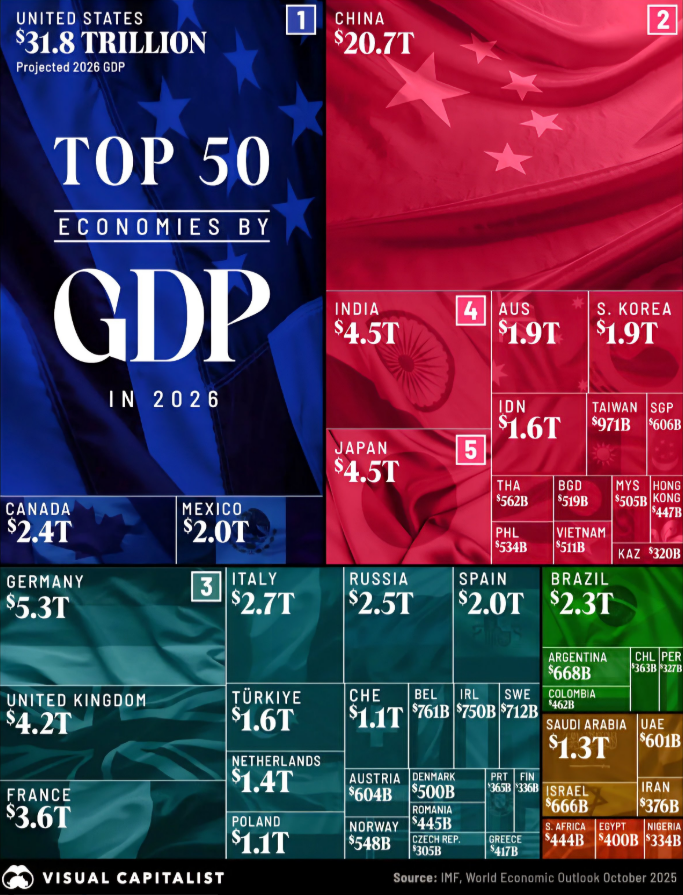
- IMF’s October 2025 projections for 2026 nominal GDP, with the US leading at $31.82 trillion and a widening gap over China’s $20.65 trillion, reflecting sustained American economic dominance amid global slowdown forecasts of 3.1% growth.
- India’s projected $4.51 trillion GDP positions it to surpass Japan and challenge Germany for third place by 2026, driven by 6.5% annual growth in emerging markets, highlighting Asia’s rising share of global output at over 50%.
- Mid-tier shifts show volatility, like Nigeria’s 49th ranking at $334 billion amid oil dependency challenges, while Poland’s climb to 20th at $1.11 trillion underscores Eastern Europe’s post-pandemic resilience with 3.2% growth.
Top 5 in 2026 (IMF Projections)
- United States — $31.82 trillion
- China — $20.65 trillion
- Germany — $5.33 trillion
- India — $4.51 trillion
- Japan — $4.46 trillion
(For context, 2025 projections were roughly: U.S. $30.62T, China $19.40T, Germany $5.01T, Japan $4.28T, India $4.13T — so India has just overtaken Japan.)
Trends and Outlook for Each
- United States: Remains the unchallenged leader with steady ~2.0–2.5% annual real GDP growth projected through 2027. Drivers include tech/AI investment, strong consumer spending, and resilient services. Longer-term (2026–2030), the U.S. is expected to add ~$5 trillion in nominal GDP — second only to China in absolute terms. Risks: elevated inflation and potential trade-policy volatility, but innovation keeps it dominant.
- China: Holds a solid #2 spot but growth is decelerating (projected ~4.2–4.5% real GDP in 2026–2027). It will still add the most absolute GDP globally (~$5.7T from 2026–2030) thanks to sheer scale. Headwinds include real-estate deleveraging, demographics (aging/shrinking workforce), and shifting export dynamics. Still, its manufacturing and tech push (e.g., EVs, AI) ensure continued absolute gains.
- Germany: Stable #3 in Europe’s largest economy, but growth is sluggish (~0.9–1.1% real GDP). It relies heavily on exports (autos, machinery) and faces energy-transition costs, aging population, and weak domestic demand. It is projected to add ~$686 billion by 2030 — respectable but trailing the top two by a wide margin. Structural reforms in labor and energy will be key to avoiding further slippage.
- India: The breakout story. Fastest growth among the top 5 (~6.4–6.9% real GDP) fueled by demographics (young workforce), digital/infrastructure reforms, and rising domestic consumption. It has already leapfrogged Japan and is closing the gap on Germany. By 2030 it is forecast to add ~$2.1T — more than any other except the U.S. and China. Challenges remain in manufacturing scale-up and inequality, but momentum is clearly upward.
- Japan: Holding #5 with modest ~0.7–1.1% growth. Long-term issues (aging/declining population, high public debt) cap upside, though corporate profits, tourism recovery, and tech investments provide some support. It adds a solid ~$656 billion by 2030 but risks being overtaken further by faster-emerging Asian peers.
Overall Trends: The global economic order is remarkably stable at the pinnacle (U.S. and China together account for ~40–42% of world GDP), yet Asia’s rise is unmistakable — India’s rapid climb and China’s absolute scale dominate incremental growth. Advanced economies (U.S., Germany, Japan) are growing slower than emerging ones, reflecting demographics and maturity. Global growth itself is projected to hover around 3.1–3.3% in 2026–2027, with divergence between tech-driven resilience and structural drags (energy, debt, geopolitics).
My Opinion
This snapshot is bullish on continuity with quiet disruption. The U.S. isn’t going anywhere as #1 — its innovation ecosystem (AI, finance, energy independence) gives it unmatched adaptability. China’s scale is awe-inspiring, but its slowdown feels structural rather than temporary; without productivity breakthroughs, the gap with the U.S. may widen again in relative terms. Germany and Japan illustrate the classic “mature-economy trap” — they punch above their weight in quality but lack the demographic fuel for rapid expansion.
India is the one to watch: if it sustains 6%+ growth and executes on reforms, it could realistically challenge Germany for #3 within a decade. The bigger picture? The world economy is diversifying away from pure U.S.-China bipolarity. That’s healthy — more centers of growth reduce systemic risk. As long as trade stays (mostly) open and technology keeps boosting productivity, these projections feel realistic and even a bit conservative. The real wildcard will be geopolitics and AI’s productivity payoff — whoever harnesses those best will pull ahead fastest.