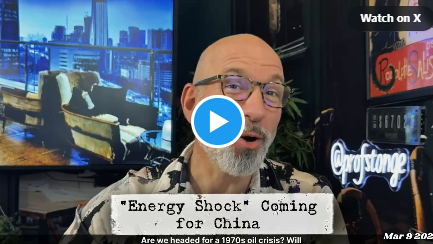

Will we see 1970’s oil shortages? Thanks to Trump, America doesn’t need Middle East oil. But Asia needs it to survive. India runs out in 1 month. Thailand and Vietnam in 2. China runs out in 3. At which point they’ll start shutting down their economies. – Peter St Onge
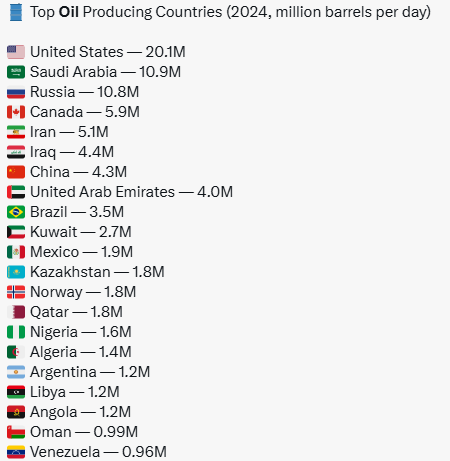
They can buy from the U.S. instead of Iran and the gulf states. Why not? We now produce more oil than the next two powers combined thanks to Trump. Saudi Arabia and Russia combined are now outproduced by the U.S. and it will get even more lopsided as each month passes.
Will we see 1970’s oil shortages?
Thanks to Trump, America doesn’t need Middle East oil. But Asia needs it to survive.
India runs out in 1 month.
Thailand and Vietnam in 2.
China runs out in 3.At which point they’ll start shutting down their economies. pic.twitter.com/O8iadoDQLD
— Peter St Onge, Ph.D. (@profstonge) March 9, 2026
- Even with Asia’s heavy reliance on Middle East oil, China’s massive stockpiles and alternative suppliers make full economic shutdowns in just 1–3 months highly unlikely, but what do you think happens to global prices and supply chains if the Strait of Hormuz stays blocked for months?
Here’s a small pie chart breakdown of the main oil-producing countries as a percentage of global output. This is based on the most recent reliable data available (primarily 2023–2024 figures from sources like EIA, Worldometers, and related reports, as monthly global totals fluctuate but shares remain relatively stable in the short term; note that “oil” here typically includes crude oil, condensate, and sometimes broader liquids).The top producers dominate global supply, with the U.S. leading by a wide margin.
- United States: ~22%
- Saudi Arabia: ~11%
- Russia: ~11%
- Canada: ~6%
- China: ~5%
- Others (including Iraq, Brazil, UAE, Iran, Kuwait, and all remaining countries): ~45%
This adds up to 100% of global production (approximately 100–102 million barrels per day in recent totals, varying slightly by month and source).