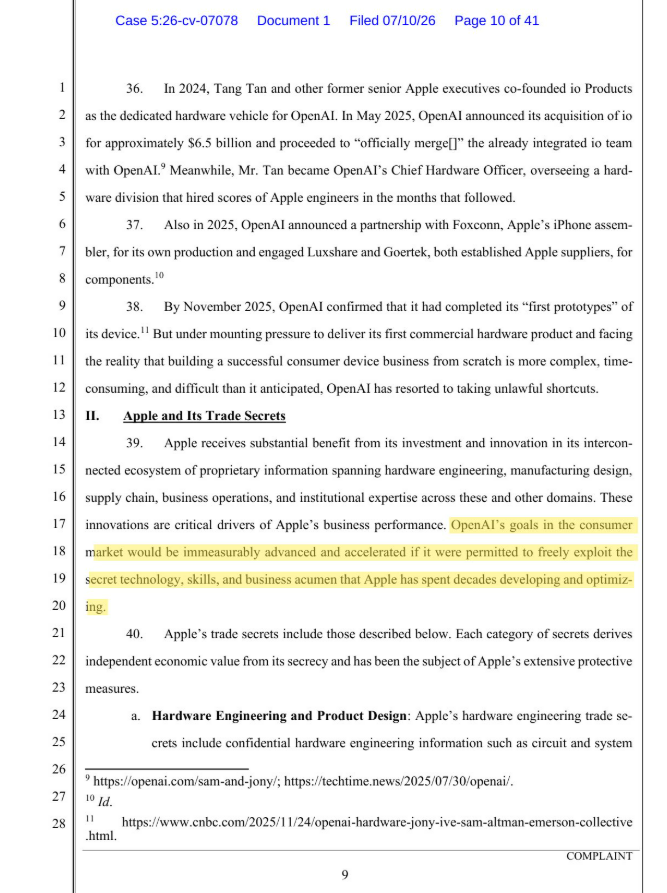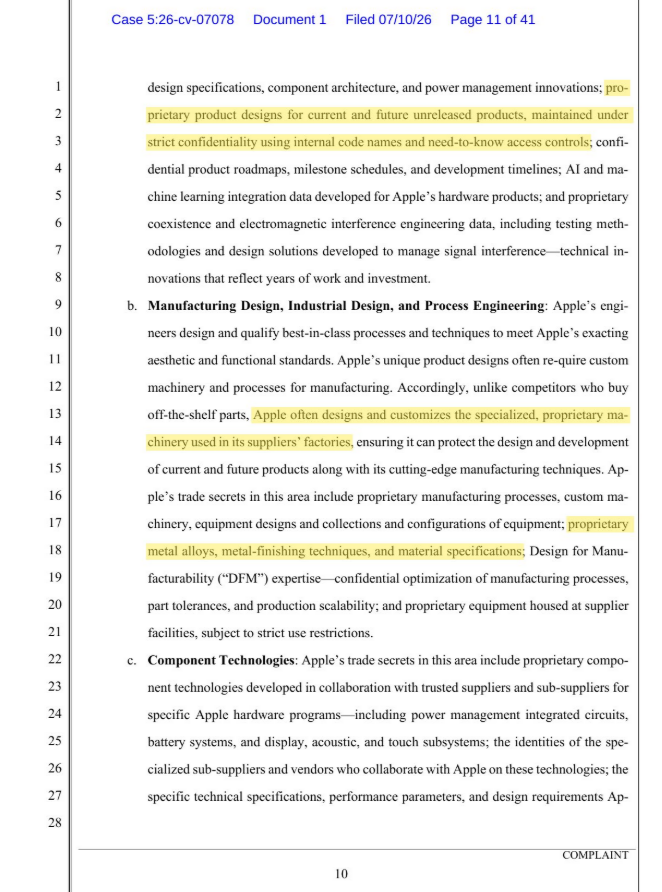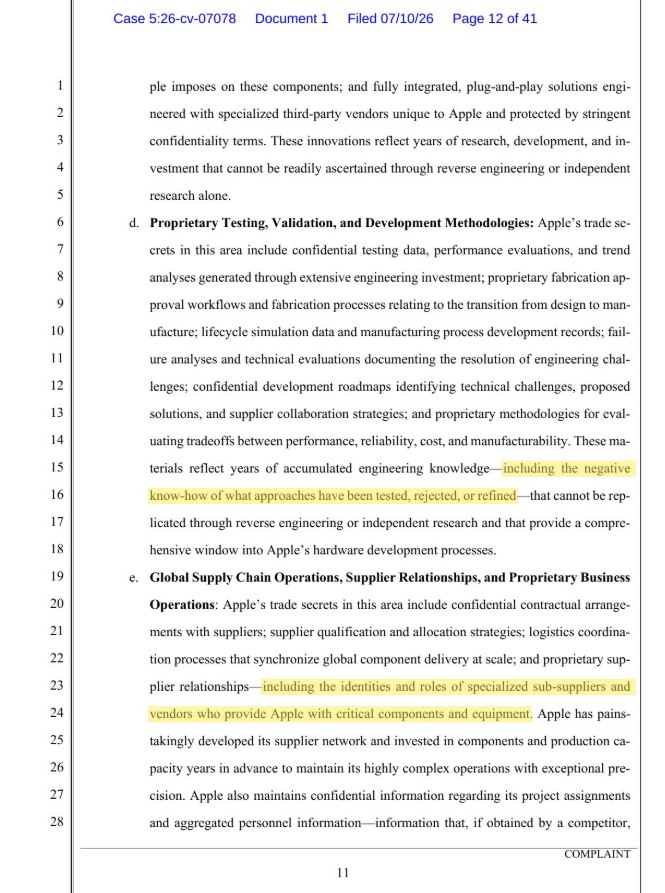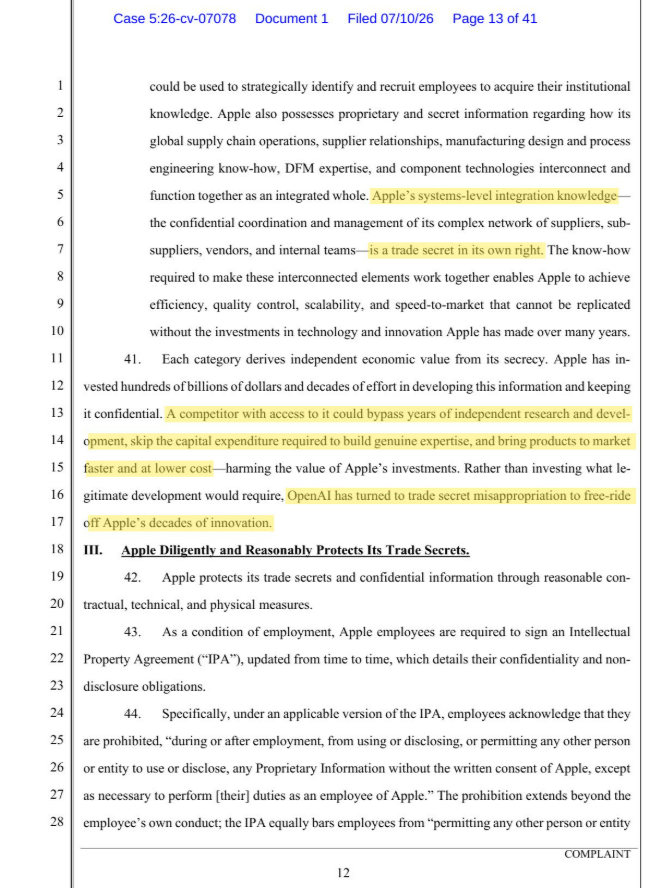
They sure put a lot of effort into this crime https://t.co/zo6areZrFX
— Elon Musk (@elonmusk) July 11, 2026
Whatfinger’s Take On The News: Apple vs OpenAI – The Crew Breaks It Down
The fluorescent lights hummed in the Whatfinger war room as the team gathered around the big screen. Coffee cups steamed. A half-eaten box of donuts sat ignored on the table next to a small American flag someone had stuck in a mug years ago.
Michael Anthony leaned back in his chair. “Apple just sued OpenAI. Claims they ran a full-court press stealing hardware trade secrets to build rival AI devices. Luke, walk us through it.”
Luke didn’t look up from his screen. He was already deep in the documents. “Straight from the source this morning: Apple Sues OpenAI Alleging Systematic Theft of Hardware Trade Secrets to Fuel Rival AI Devices. Apple filed in federal court in Northern California yesterday. They’re not accusing one rogue engineer. They’re saying OpenAI ran a coordinated campaign — at every level — to siphon decades of Apple hardware know-how.”
He scrolled. “We’re talking unreleased product designs, manufacturing processes, supply chain strategies, power management systems, even ‘negative know-how’ — the expensive lessons from things that didn’t work. They name two former Apple guys specifically: Tang Yew Tan, who was VP of Product Design for iPhone and Apple Watch for 24 years, and Chang Liu, a senior systems electrical engineer. Apple says Tan was coaching people on how to beat Apple’s offboarding security and using internal codenames to fish for info during interviews. Liu allegedly kept an Apple laptop and exploited a bug to download dozens of confidential files after he left.”
Alex let out a low whistle. “So the company that brands itself ‘Open’AI is out here playing corporate espionage like it’s the Cold War? That’s rich. What happened to ‘we’re just here to benefit humanity’?”
Luke kept going, voice flat. “This isn’t happening in a vacuum. Remember when Elon was still fighting them in court? Musk says he’ll appeal dismissal of lawsuit against OpenAI. He co-founded the thing as a non-profit to keep AI open and safe. They went for-profit, went closed, and he sued. Now Apple — the company that partnered with them on Apple Intelligence back in 2024 — is saying OpenAI poached hundreds of their people and turned them into a hardware theft pipeline while they were still supposedly ‘partners.’ Apple even reached out in February. Radio silence. So here we are.”
Sgt. Pat crossed his arms, jaw tight. “Poaching talent is business. Smuggling prototypes and teaching people how to dodge security protocols? That’s not competition. That’s preparation.”
He takes scamming to a whole new level https://t.co/o6TMllhIMu
— Elon Musk (@elonmusk) July 11, 2026
The Cost
Lisa shook her head. “Think about the engineers who spent twenty years at Apple building this stuff. They poured their lives into it. Now some of that knowledge is allegedly walking out the door in backpacks and being used to compete against the very company that trusted them. It’s not just corporate. It’s personal betrayal.”
Beth nodded slowly. “And it erodes trust everywhere. If the big players can’t even keep their own house secure, how are regular people supposed to feel about the tech running their lives? This stuff powers everything now — phones, cars, medical devices. When the foundation gets stolen, everybody downstream pays.”
Alex leaned forward, half-grinning but serious underneath. “Let’s be honest about the branding. ‘Open’AI stopped being open the second it became convenient. Elon called it years ago. Now Apple’s learning the same lesson the hard way. You don’t hand your crown jewels to people whose mission statement changes with the funding round.”
Sgt. Pat didn’t smile. “This is why borders and loyalty still matter — even in Silicon Valley. You can’t build generational advantage if the people holding the keys have divided allegiances or if the system rewards the fastest thief. AI hardware isn’t a toy. It’s the new high ground. Lose control of it and you’re not just losing market share. You’re losing leverage in every future conflict that matters.”
The room went quiet for a second.
Ben, who had been listening with that calm, measured look he always got when the pieces started fitting together, finally spoke. “There’s an old line from Proverbs that fits: ‘The wicked borroweth, and payeth not again.’ But the real danger isn’t just the theft. It’s the mindset that treats another man’s work — decades of it — as something you’re entitled to because you’re moving faster. The Founders understood this. They protected intellectual property in the Constitution itself because they knew a nation that doesn’t respect creation eventually stops creating. It starts consuming what others built. We’ve seen empires rot from the inside that way.”
He looked around the table. “OpenAI can deny it all they want. The lawsuit says the rot is already in the hardware roadmap. Apple’s asking for an injunction. If they get it, some of those ‘innovative’ devices might never see daylight. That’s not tragedy. That’s consequence.”
Luke closed his laptop. “We’ve been tracking this pattern for years — the talent wars, the IP fights, the slow realization that not everyone plays by the same rules. This is just the latest chapter.”
Michael Anthony stood up and stretched. “So what’s the Whatfinger Take?”
Nobody rushed to answer. Then Sgt. Pat spoke first.
“Protect what you build. Vet who you let in. And never mistake branding for character.”
Alex raised his coffee. “And maybe stop pretending ‘open’ means they won’t lock you out — or clean you out — the second it serves them.”
Ben nodded once. “Creation is hard. Theft is easy. The difference shows up in court… and in history.”
Elon Musk warned Apple about OpenAI two years ago. pic.twitter.com/RVJ6sQbX6q
— DogeDesigner (@cb_doge) July 10, 2026
For the complete details straight from the filing and reporting, here’s the full original story:
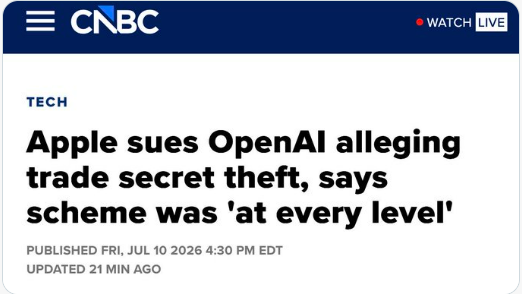
Apple Sues OpenAI Alleging Systematic Theft of Hardware Trade Secrets to Fuel Rival AI Devices
In a blockbuster lawsuit filed Friday in U.S. District Court for the Northern District of California, Apple accused OpenAI of orchestrating a coordinated campaign to steal its most valuable hardware trade secrets—spanning decades of engineering know-how and hundreds of billions of dollars in investment—as the AI company races to build its own consumer hardware products. It looks like OpenAI is facing legal troubles for a very long time. Competitors are set to eat them alive if this all comes to fruition. Let’s be blatantly obvious about why this happens: Hiring ethnic Chinese to work at any tech company means your data is at risk and most likely will be or is being stolen, as these good folks from China have relatives still there and the pressure from the CCP on them is too huge to overcome. They will spy or they will die with family. What would you do? Knowing this, you get an understanding of what is happening and has taken place in all American tech companies.
The complaint paints a dramatic picture of alleged misconduct “at every level,” from technical staff to OpenAI’s Chief Hardware Officer, involving former Apple employees who allegedly smuggled out confidential information on unreleased products, manufacturing processes, component technologies, testing data, and supply chain strategies. Apple is seeking an injunction to halt any use of the stolen secrets, the return of materials, and damages for what it calls misappropriation that has left OpenAI’s nascent hardware business “rotten to its core.”
NEWS: Apple just sued OpenAI, claiming the company stole its trade secrets “at every level”, from technical staff to the Chief Hardware Officer, to build competing consumer hardware.
Involved ex-Apple employees now working at OpenAI on AI hardware development. pic.twitter.com/AQVMqsfZwF
— DogeDesigner (@cb_doge) July 10, 2026
Background: From Partners to Rivals
Apple and OpenAI struck a high-profile partnership in 2024, integrating ChatGPT into Apple Intelligence as a fallback for Siri. That relationship has soured as OpenAI aggressively pursued hardware ambitions. In 2025, OpenAI acquired io Products—the design startup co-founded by former Apple Chief Design Officer Jony Ive—for approximately $6.5 billion. OpenAI has since poached hundreds of Apple alumni and is reportedly preparing consumer AI hardware devices, with prototypes already completed and initial products possibly imminent.
Apple claims it first contacted OpenAI in February 2026 about the alleged thefts but received no meaningful response, prompting the lawsuit.
The Alleged Playbook Theft
Apple’s complaint details a pattern of alleged misconduct centered on two named former Apple employees now at OpenAI:
- Tang Yew Tan (also referred to as Tang Tan), OpenAI’s Chief Hardware Officer and a 24-year Apple veteran who most recently served as VP of Product Design for iPhone and Apple Watch. He co-founded io Products and is accused of systematically leveraging his insider knowledge.
- Chang Liu, a former senior systems electrical engineer at Apple for eight years who joined OpenAI in January 2026. He is accused of retaining an Apple-issued laptop and exploiting a security bug to download dozens of confidential files after his departure.
Key allegations include:
- Directing job candidates still employed at Apple to bring physical components—such as batteries, logic boards, and other parts—from Apple offices to OpenAI interviews for “show and tell” sessions to elicit confidential details. One candidate reportedly expressed surprise, saying they “didn’t even know we could take those from the office.”
- Coaching departing or prospective employees on evading Apple’s security and offboarding protocols, including circulating internal Apple documents on how to avoid scrutiny.
- Using internal Apple codenames for unreleased projects during recruiting to probe candidates for sensitive information.
- Allegedly misleading manufacturing partners about Apple’s involvement or permission while seeking to replicate proprietary techniques.
These actions, Apple argues, targeted the full spectrum of its hard-won hardware expertise:
Hardware Engineering — Circuit designs, component architecture, power management systems, details on unreleased products protected by internal codenames, AI/ML integration approaches for hardware, and electromagnetic interference (EMI) engineering plus testing methodologies.
Manufacturing Secrets — Proprietary production processes and custom machinery, specialized equipment Apple designs and installs directly in supplier factories, proprietary metal alloys and finishing techniques, and deep Design for Manufacturability (DFM) expertise honed over decades.
Component Technologies — Advanced power chips, battery systems, displays, acoustics, touch interfaces, identities of specialized sub-suppliers, and the exact performance specs Apple demands from component makers.
Testing Data — Extensive failure analyses, lifecycle simulations, and crucially, “negative know-how”—the hard-won lessons from everything Apple tried that ultimately didn’t work, saving rivals enormous time and cost.
Supply Chain — Supplier contracts and allocation strategies, global logistics coordination, and systems-level integration knowledge that underpins Apple’s ability to deliver complex products at massive scale.
Apple’s Position and OpenAI’s Response
Apple frames the alleged theft not as isolated incidents but as an institutional pattern that has given OpenAI an unfair shortcut in its hardware ambitions. The company emphasizes that these secrets represent “hundreds of billions of dollars [and] decades of work.”
OpenAI has denied the allegations, stating: “We have no interest in other companies’ trade secrets. We remain focused on building innovative technology that empowers people everywhere.”
Why This Matters
This lawsuit represents a major escalation in the AI hardware race and a sharp break between two former collaborators. It highlights the intense competition for talent and intellectual property as companies race to move AI from software into physical devices that could redefine consumer interaction.
Legal experts note that trade secret cases like this often hinge on specific evidence of misappropriation and can result in significant injunctions that slow or reshape a defendant’s product roadmap. With OpenAI preparing hardware launches and exploring a potential IPO, the stakes are extraordinarily high.
The case is Apple Inc. v. OpenAI et al., filed in the Northern District of California. It names OpenAI entities, io Products, Tang Yew Tan, and Chang Liu as defendants. Jony Ive is not named in the complaint.
As the legal battle unfolds, the tech world will be watching closely to see how much of Apple’s vaunted “playbook” OpenAI allegedly absorbed—and whether the courts will allow the AI giant to keep using it.