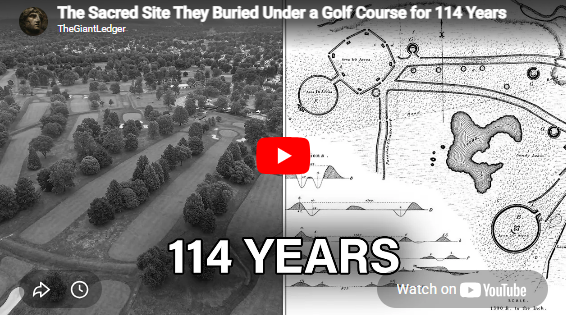


June 26th, 2002. A 73-year-old Cherokee woman named Barbara Crandell removed her shoes, walked barefoot across a private golf course in Newark, Ohio, and knelt on a two-thousand-year-old earthen mound to pray. Security was called. She was arrested, charged with criminal trespass, and convicted by a Licking County jury. The mound she was praying on was built by people who encoded the eight extreme rise-and-set positions of an eighteen-year lunar cycle into the geometry of the surrounding structure. Two physics professors confirmed it in 1982.
The conclusion has held for over forty years and is now mainstream archaeology. The Newark Earthworks once covered four square miles. Seven million cubic feet of earth moved by hand with deer-shoulder-blade hoes. The Great Circle is twelve hundred feet across. The entire ring at Stonehenge fits inside one of the auxiliary circles. Less than ten percent of the original complex survives. The Cherry Valley Ellipse is under railroad tracks. The Wright Square is two hundred feet of one wall. The Great Hopewell Road connecting Newark to a sister lunar observatory sixty miles away is eight confirmed miles and fifty-two miles of plowed-under hypothesis.
In 1910 the state of Ohio leased the Octagon to a private country club. In 1997 the lease was renewed to 2078. Four days of public access per year. Barbara Crandell co-founded the Native American Alliance of Ohio in 1992 to fight for the site. She died in October 2019. On January 1st, 2025, the gates opened for the first time in one hundred and fourteen years. The lunar standstill cycle peaked that same year. She was not there to see it. The material on this channel presents exploratory interpretations of history and imaginative speculation, conveyed through narrative storytelling rather than precise historical documentation. Viewpoints and visual representations are dramatized or intentionally constructed to support alternative narrative exploration. Visual elements may at times be created using automated or generative tools. The content shared should not be considered factual.