



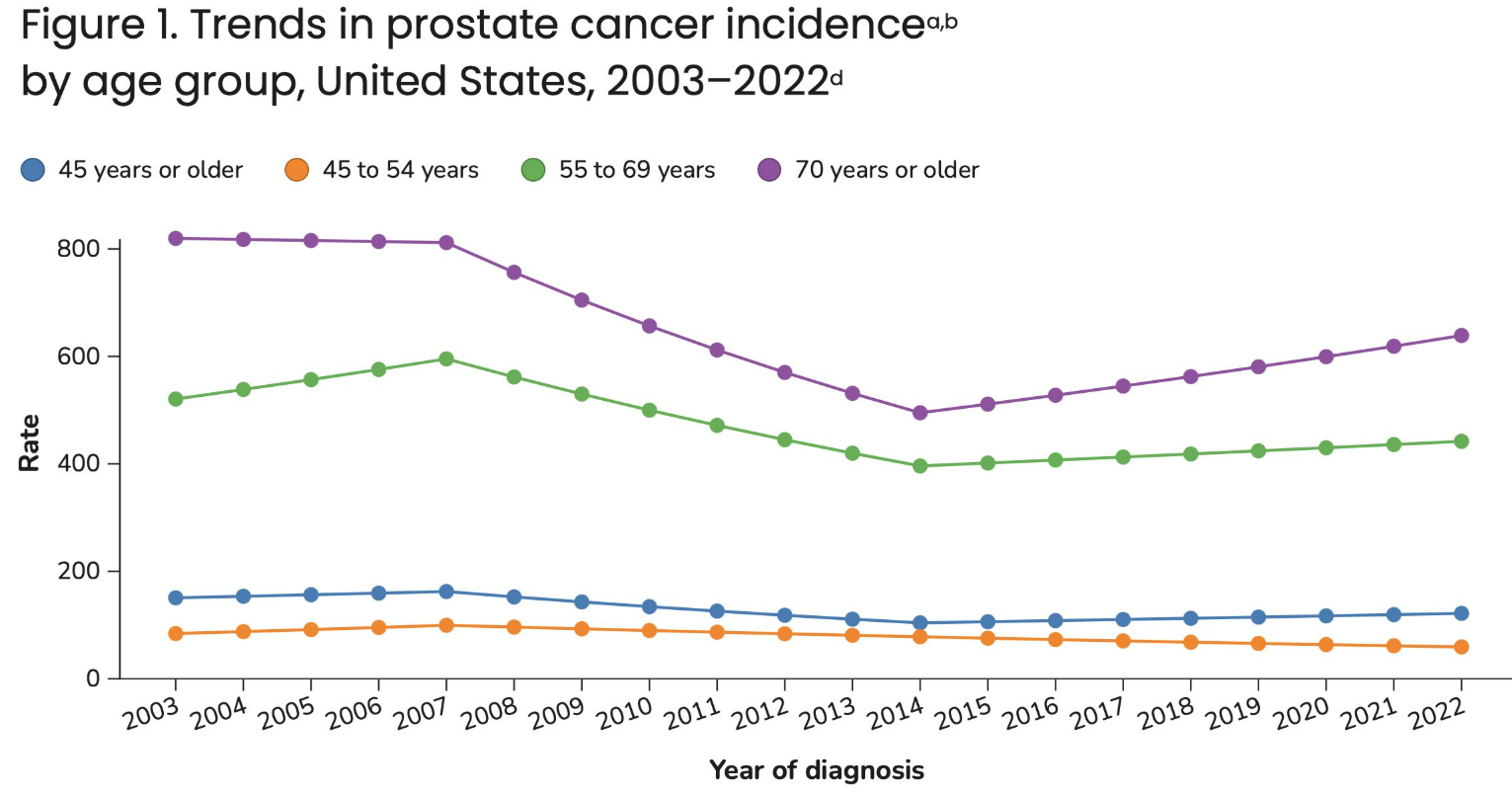
Why does the CDC’s cancer data stop at 2022?
How is it we can track measles cases by the day but have a 4 year lag in cancer data?
@CDCgov @CDCDirector @SecKennedy https://t.co/xFTBcF7dPr
— Mary Talley Bowden MD (@MaryBowdenMD) October 31, 2026
**Official CDC U.S. Cancer Statistics (USCS) incidence data, as of late October 2026, extend through diagnosis year 2023 (released around June 2026), not 2022. ****[](<cdc.gov/united-states->) The CDC’s Data Visualizations tool (released June 2026) and related pages state that 2023 is the most recent year of incidence data available, with 1,941,540 new invasive cancers reported that year, and that mortality data are available through 2024. The public-use database (2025 NPCR/SEER submissions, released June 2026) covers diagnoses from 2001 through December 31, 2023.[](<cdc.gov/united-states->) The chart attached to the post is labeled “Trends in prostate cancer incidence by age group, United States, 2003–2022.” That specific figure ends in 2022, consistent with certain published analyses, older or archived views, or the 2026 Annual Report to the Nation (which uses incidence trends through 2022 for its short-term analyses). CDC WONDER’s interface still lists incidence through 2022 in some listings. The primary official interactive tools and CDC statements confirm 2023 is available. SEER also publishes preliminary (non-official) delay-adjusted estimates through 2024 for selected registries meeting completeness criteria, based on earlier February submissions.[](<seer.cancer.gov/statistics/pre>) ### Why the multi-year lag exists Cancer incidence is not a simple real-time case count. Central registries (state-level NPCR and SEER) receive reports from hospitals, pathology labs, outpatient clinics, radiation facilities, and other sources. Cases require detailed abstraction (primary site, histology, stage, first-course treatment, demographics), coding to standardized systems, consolidation when multiple reports exist for the same person, interstate data exchange, deduplication, and rigorous quality checks. Registries must meet high completeness thresholds (typically >98%) to be included in national high-quality statistics. Standard timelines include roughly a 22–23 month window after the close of a diagnosis year for initial federal submission (e.g., 2023 cases submitted in late 2025), followed by processing, verification, and public release the following spring/summer (2026 for 2023 data). Even then, late reports continue to arrive, so delay-adjustment models are applied; a few percentage points typically undercount the most recent year until later updates are made. Mortality data from death certificates (via NCHS) move somewhat faster.[](<surveillance.cancer.gov/delay/>) This process has been standard for decades. It prioritizes accuracy, completeness, and utility for research, trend analysis, disparities, survival, and cancer control over speed. Certified tumor registrars are a limited workforce, and the system has faced documented strains (volume, data complexity, costs). Professional literature has called for modernization toward faster electronic reporting while preserving quality; COVID-era disruptions further highlighted the limits of timeliness for real-time surveillance.[](<ascopubs.org/doi/10.1200/JC>)
**Official CDC U.S. Cancer Statistics (USCS) incidence data, as of late October 2026, extend through diagnosis year 2023 (released around June 2026), not 2022. ****[](<https://t.co/BxA1xqFQ6k>)
The CDC’s Data Visualizations tool (released June 2026) and related pages state that 2023 is the most recent year of incidence data available, with 1,941,540 new invasive cancers reported that year, and that mortality data are available through 2024. The public-use database (2025 NPCR/SEER submissions, released June 2026) covers diagnoses from 2001 through December 31, 2023.[](<https://t.co/gEdZIINURx>)
The chart attached to the post is labeled “Trends in prostate cancer incidence by age group, United States, 2003–2022.” That specific figure ends in 2022, consistent with certain published analyses, older or archived views, or the 2026 Annual Report to the Nation (which uses incidence trends through 2022 for its short-term analyses). CDC WONDER’s interface still lists incidence through 2022 in some listings. The primary official interactive tools and CDC statements confirm 2023 is available. SEER also publishes preliminary (non-official) delay-adjusted estimates through 2024 for selected registries meeting completeness criteria, based on earlier February submissions.[](<https://t.co/OM1YElJYoA>)
### Why the multi-year lag exists
Cancer incidence is not a simple real-time case count. Central registries (state-level NPCR and SEER) receive reports from hospitals, pathology labs, outpatient clinics, radiation facilities, and other sources. Cases require detailed abstraction (primary site, histology, stage, first-course treatment, demographics), coding to standardized systems, consolidation when multiple reports exist for the same person, interstate data exchange, deduplication, and rigorous quality checks. Registries must meet high completeness thresholds (typically >98%) to be included in national high-quality statistics.Standard timelines include roughly a 22–23 month window after the close of a diagnosis year for initial federal submission (e.g., 2023 cases submitted in late 2025), followed by processing, verification, and public release the following spring/summer (2026 for 2023 data). Even then, late reports continue to arrive, so delay-adjustment models are applied; a few percentage points typically undercount the most recent year until later updates are made. Mortality data from death certificates (via NCHS) move somewhat faster.[](<https://t.co/XFuoc038Ja>)
This process has been standard for decades. It prioritizes accuracy, completeness, and utility for research, trend analysis, disparities, survival, and cancer control over speed. Certified tumor registrars are a limited workforce, and the system has faced documented strains (volume, data complexity, costs). Professional literature has called for modernization toward faster electronic reporting while preserving quality; COVID-era disruptions further highlighted the limits of timeliness for real-time surveillance.[](<https://t.co/IBmaegh6iO>)
1of2
— Chris 🇺🇸 (@Chris_1791) October 31, 2026