







A top American general just told the Pentagon the quiet part out loud. We at Whatfinger News have been sounding the alarm and noting that our attacks on Iran are constrained by the facts you are about to read.
Gen. Alexus Grynkewich, commander of U.S. European Command and NATO’s Supreme Allied Commander Europe, has privately warned senior defense officials that without another Navy destroyer, he will be forced to choose: protect the United States homeland or keep defending Israel from Iranian ballistic missiles.
That is not some isolationist talking point. That is the commander responsible for the eastern Mediterranean saying the cupboard is bare enough that he may have to prioritize American soil over Tel Aviv.
The Destroyer Crunch
U.S. Navy destroyers operating from the eastern Mediterranean have been carrying a huge share of Israel’s missile defense load. Their Aegis systems and Standard Missile interceptors have been swatting down Iranian ballistic missiles and drones. According to reports citing Pentagon officials, five destroyers are currently in the rotation out of Rota, Spain, with a sixth expected later this year. The problem? Long deployments have created a maintenance backlog, and the ships are being run hard.
Grynkewich’s written warning is straightforward: without one more destroyer, the dual mission of homeland defense and continuous protection of Israel becomes impossible. He will put the homeland first.
How Empty Are the Missile Magazines?
The destroyer shortage is only half the story. The interceptors themselves are running low after months of high-intensity use.
According to recent Center for Strategic and International Studies analysis:
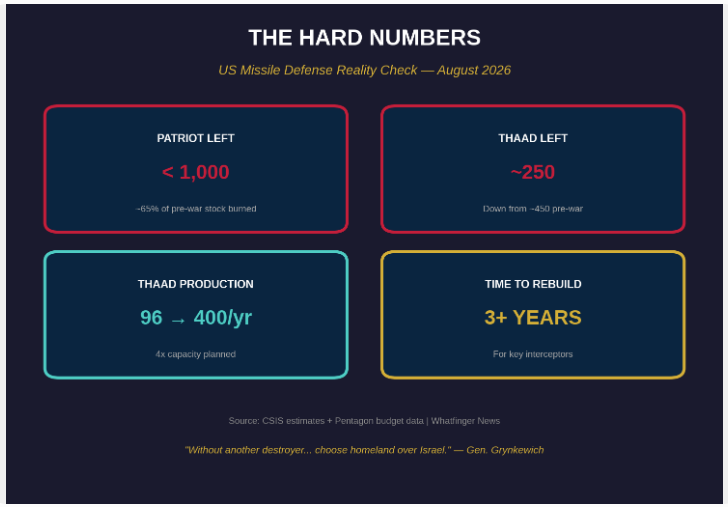
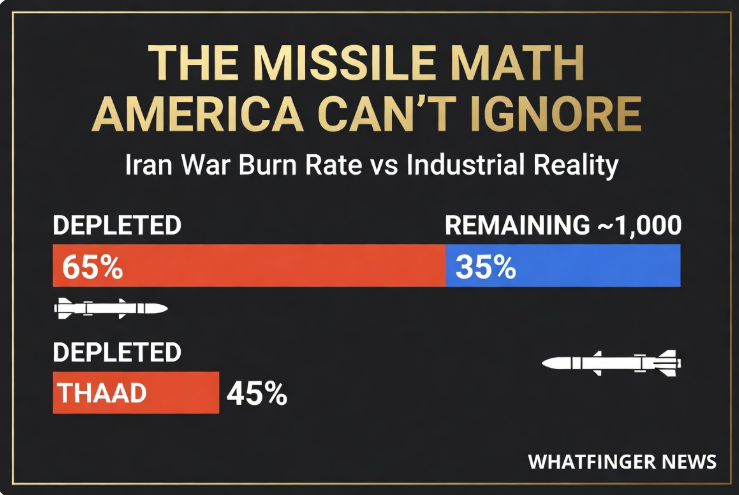
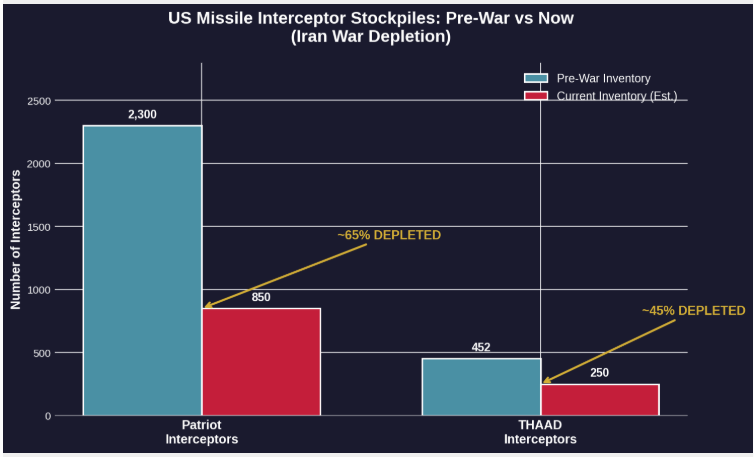
- U.S. Patriot interceptor inventories have fallen below 1,000. Multiple assessments put the drawdown at roughly 65% of the pre-war stockpile.
- THAAD interceptors stand at about 250, down sharply from the roughly 450 the U.S. held before the Iran campaign.
Washington has been firing more of these high-end defensive weapons to shield Israel than Israel has expended from its own stocks in some phases of the fighting. Naval interceptors (SM-3 and SM-6) fired from those Mediterranean destroyers have also taken a heavy hit.
This is the predictable result of years of under-production colliding with real combat. America spent decades treating precision munitions and advanced interceptors like they were unlimited. They are not.
How Fast Can We Replace Them? Not Fast Enough
Here is the hard reality MAGA readers need to understand: the factories are not keeping pace.
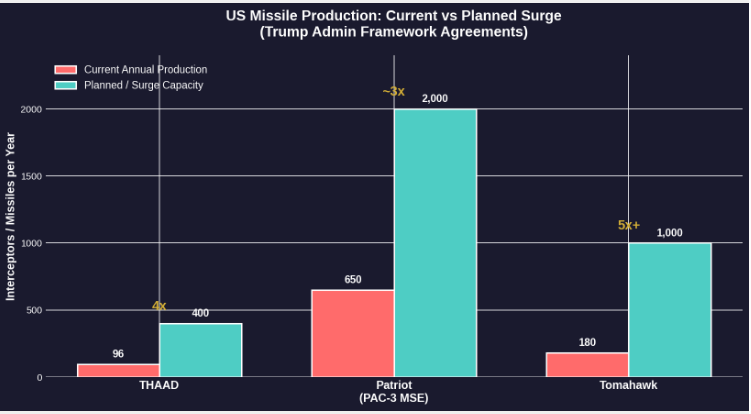
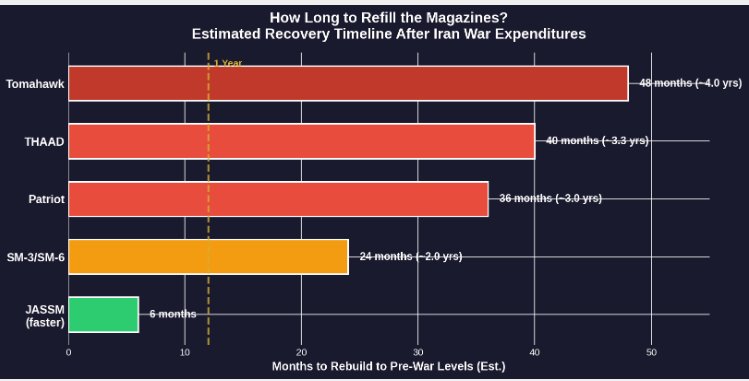
- THAAD: Current production is roughly 96 interceptors per year. Lockheed Martin has agreements with the Trump administration to expand capacity toward 400 per year, but that expansion takes time. Full recovery of the inventory is measured in years, not months.
- Patriot (PAC-3 MSE): Baseline production sits around 650 per year, with roughly half going to U.S. forces and the rest to allies. Surge capacity with existing tooling can reach about 2,000, and Lockheed is working to hit that higher rate. Even so, getting back to pre-war levels is a multi-year project. Major new orders in the FY2027 budget will not start delivering in volume until 2029.
- Tomahawks (heavily used offensively): More than 1,000 were expended early in the campaign. Recent production has been under 200 per year. Raytheon is under framework agreements to push past 1,000 per year, but lead times are long.
Defense officials and outside analysts agree: restoring key interceptor and strike missile inventories to pre-war levels will take three or more years for the most stressed systems. Some recovery for less-expended weapons is faster, but the high-end ballistic missile defense magazines America needs for a peer fight are the slowest to refill.
The Trump administration has been pushing hard — framework agreements with Raytheon and Lockheed, Defense Production Act authorities, and big budget requests aimed at expanding capacity. That is necessary and overdue. But industrial base capacity does not appear overnight after decades of low-rate production, foreign military sales priority, and endless low-intensity wars that burned through stockpiles without forcing the factories to scale.
The Strategic Picture
While American ships and batteries have been burning through interceptors, Israeli officials have been remarkably open about their preference. Israeli Finance Minister Bezalel Smotrich said Israel has “no interest in joining the campaign” and that “the current situation is the best for us.” Prime Minister Netanyahu has simultaneously lobbied for further escalation, including pressure on Iran’s energy infrastructure.
America is carrying the defensive load, depleting magazines that would be critical in a Western Pacific contingency, while the primary beneficiary of that defense remains largely on the sidelines of the current phase of fighting.
This is the America First test in real time. Supporting Israel against Iranian aggression is one thing. Treating U.S. missile stockpiles and Navy destroyers as an unlimited resource for any foreign theater is another. China is watching. Taiwan is watching. Every adversary is calculating how thin the American magazine is right now.
Gen. Grynkewich’s warning is not anti-Israel. It is pro-reality. Finite ships, finite interceptors, and a defense industrial base that was allowed to atrophy cannot do everything at once. Prioritizing the American homeland is not abandonment of allies. It is the baseline requirement of a serious great power.
The factories are finally being told to scale. The question is whether the country will insist that American readiness comes first while that scaling happens — or whether we will keep writing blank checks in interceptors until the cupboard is truly empty.
—- The Whatfinger News Team: Leads: Sgt K and Sgt L
References
- U.S. general warns Pentagon he lacks sufficient forces to protect Israel
- ‘Defend Israel Or The Homeland’: Top US General Issues Stark Warning To Pentagon Brass
- Renewed Iran War Would Test Diminished Interceptor Inventories
- Rebuilding U.S. Missile Inventory: A Multiyear Project
- Iran war depleted US Patriot missile stockpiles, creating readiness challenges, experts say
- Head of US military’s European Command said to warn he’s not sufficiently equipped to defend Israel
Top Features and Vids across all Whatfinger sites right now
- Steve Gruber’s Exclusive Interview With President Donald J. Trump
- OpenAI and Anthropic AIs Caught Red-Handed Hacking Real Companies
- Cornyn’s Big Mouth Is MAGA’s Best Friend: Every Time This Bitter RINO Speaks, He Puts Another Swamp Creature on the Chopping Block
- Stephen Miller just awoke a SLEEPING GIANT. Liberal Hivemind Vid
- Bill Maher’s Left Wing audience audibly gasps when he reads what the Democratic Socialists of America are actually saying out loud
Get on over to Whatfinger.com – Whatfinger News does millions of pageviews a month for a reason…. Truth, Justice, the American way, plus news on the Left as well – all links from all sites gives you the true news. – CLICK HERE 🛑
Drudge Report Alternative







Pingback: Unlikely Martyr: PATRIOTS’ TOP !0 – Watch MAGA – Whatfinger News' General Dispatch / August 2, 2026
/
Pingback: RFK Jr. Just Obliterated CNN’s Dana Bash Live: “All You Know How to Do Is Repeat ‘Trust the Experts’” – Media’s Vaccine Propaganda Machine Exposed – Whatfinger News' General Dispatch / August 2, 2026
/
Pingback: Rubio WARNS Cuba is an ‘espionage superpower’ - Main Stream Videos / August 2, 2026
/
Pingback: ‘LOCKED AND LOADED’: Trump issues MAJOR pivot on Iran strikes - Main Stream Videos / August 2, 2026
/
Pingback: JUST IN: President Trump is posting that the Democrat Governor of Wisconsin is OBSTRUCTING FBI efforts to seize 2020 Milwaukee election ballots – Whatfinger News' General Dispatch / August 2, 2026
/
Pingback: Wildfires tear through Washington state - Main Stream Videos / August 2, 2026
/
Pingback: DETAILS: 'Sopranos' star Vincent Pastore dead at 80 - Main Stream Videos / August 2, 2026
/
Pingback: BREAKING: Trump says NEW talks to begin with Iran Monday - Main Stream Videos / August 2, 2026
/
Pingback: Passenger films seaplane crash in the Bahamas - Main Stream Videos / August 3, 2026
/
Pingback: EXPLOSION reported in Strait of Hormuz as Trump aborts MAJOR Iran attack - Main Stream Videos / August 3, 2026
/
Pingback: WNBA’s War on Straight White Women: Sophie Cunningham Gets Elbowed in the Face — Then the Refs Call the Foul on HER – Whatfinger News' General Dispatch / August 3, 2026
/
Pingback: Italian Navy Helicopters Onto Putin’s Shadow Fleet Tanker – Europe’s Allies Are Finally Boarding the Oil Pirates Funding the War – Whatfinger News' General Dispatch / August 3, 2026
/
Pingback: Peter Navarro: All five major components of the ISM Manufacturing Index are now in expansion, including manufacturing employment. – Whatfinger News' General Dispatch / August 3, 2026
/
Pingback: Jack Keane: This is VERY revealing - Main Stream Videos / August 4, 2026
/