Excellent Details and Info are below this top clip – which envisions what they would look like from the mummies that are well preserved. Read below.
Their story upends simple migration narratives while leaving key questions about language, cultural transmission, and long-term genetic impact unresolved.
In the hyper-arid Taklamakan Desert of the Tarim Basin, natural desiccation preserved hundreds of bodies dating roughly from 2100–1700 BCE (and later into the Iron Age). Early 20th-century explorers such as Aurel Stein and Sven Hedin first encountered them; systematic excavations in the late 20th century, especially at sites like Xiaohe, Gumugou (Qäwrighul), Loulan, and Cherchen, revealed striking remains. Many individuals had fair to reddish or blond hair (often braided or long and curly), high noses, deep-set eyes, and relatively tall stature. Clothing included woolen textiles with twill and tartan-like patterns, felt hats, leather boots, and boat-shaped coffins—features that long suggested Western Eurasian connections.
Notable examples include the “Beauty of Loulan” (c. 1800 BCE, auburn hair), the “Princess of Xiaohe,” and the tall, red-haired “Cherchen Man” (c. 1000 BCE) with his tartan leggings. Later Iron Age individuals from Subeshi include the so-called “Witches of Subeshi,” women buried in tall, conical black felt hats that resemble later European stereotypes of witches’ headgear (though such pointed hats appear in various Central Asian contexts). These physical traits fueled decades of debate.
Earlier Theories of Western Origins
For much of the 20th century, scholars linked the mummies to Indo-European migrations. The Afanasievo culture of the Altai region (linked to Yamnaya-related steppe pastoralists) was a leading candidate for bringing Proto-Tocharian speakers eastward. Others pointed to the Bactria-Margiana Archaeological Complex (BMAC) or Inner Asian Mountain Corridor groups. Textile techniques and pastoral practices seemed to support western or southwestern influxes. The later attested Tocharian languages (centum Indo-European languages written in the Tarim Basin from roughly the 5th–8th centuries CE) reinforced the idea of early Indo-European settlers.
Not migrants. Not Indo-European herders. Not anyone from the West.
The Tarim Basin mummies came out of the Taklamakan Desert with red and blond hair, woven wool and tartan twill. For thirty years that was read as migration off the Black Sea steppe.
In 2021 a Nature study pic.twitter.com/TmoJwSSuGl
— History by Duni (@historybyduni) July 30, 2026
The 2021 Genetic Revelation
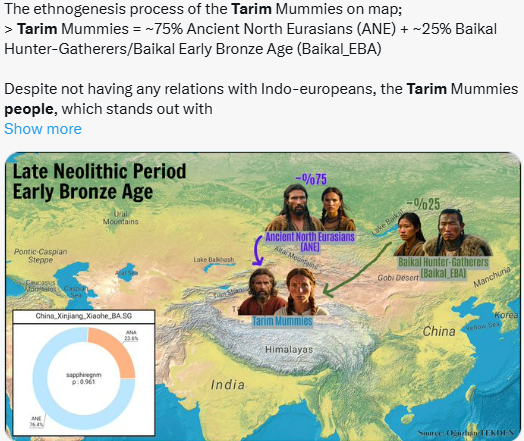
A landmark 2021 Nature study sequencing genomes from 13 early Tarim individuals (mostly Xiaohe, ~2100–1700 BCE) and comparative samples from the Dzungarian Basin overturned the migration model for the earliest group. These people belonged to a previously unrecognized genetic isolate. Their ancestry was modeled as approximately 72% Ancient North Eurasian (ANE, closest to the ~24,000–17,000-year-old Afontova Gora 3 individual from Siberia) and ~28% Ancient Northeast Asian (related to Early Bronze Age Baikal populations). There was no detectable Western Steppe (Afanasievo/Yamnaya-related) ancestry in the early Tarim sample.
The population showed signs of a severe and prolonged bottleneck, extreme genetic homogeneity, and isolation—likely facilitated by the desert environment acting as a barrier to gene flow even as ideas moved. Their gene pool appears to have formed in the early Holocene (roughly 9,000+ years ago) as a local descendant of Pleistocene ANE groups that once ranged more widely across northern Eurasia. ANE ancestry today survives at highest levels among some Indigenous Siberian and Native American populations; the Tarim group represents one of the purest Holocene remnants of that profile.
They were not culturally isolated. Dental calculus from Xiaohe individuals contained ruminant milk proteins (cattle, sheep, goat), evidence of dairy processing—among the oldest clear signs of cheese-like products in the region. They raised livestock, grew wheat, barley, and millet, and incorporated technologies and practices from neighboring groups while maintaining genetic distinctiveness. Cultural cosmopolitanism without genetic admixture is a striking pattern. Continued below this next video on these people
The ONLY thing bad about the following video is the use of the Marxist BCE (Before common era) for Before Christ – BC. Dates are the same and Leftists use BCE because they want to erase Jesus from history.
Later Developments and the Tocharian Question
Northern Xinjiang (Dzungaria) did receive Afanasievo-related ancestry around 3000 BCE. Later Bronze and Iron Age populations in the broader region show admixture involving steppe groups (including Andronovo/Sintashta-related), BMAC-related, and East Asian sources, with varying contributions from the earlier Tarim ancestry. The early Tarim isolate was gradually absorbed or diluted.
The link between the early mummies and the later Tocharian speakers remains unsettled. Afanasievo-derived groups in the north are a plausible vector for introducing an early form of Tocharian, which could later have spread or been adopted in the basin. The thousand-year gap between the best-preserved early mummies and the first Tocharian texts, plus the genetic discontinuity, means the language of the Xiaohe people themselves is unknown. Material culture continuities and geographic proximity keep the association plausible but unproven.
Did They Become Part of the Chinese?
In a narrow sense of contributing substantially to the core ancestry of Han Chinese populations farther east, no. Han Chinese ancestry is predominantly East Asian. The Tarim ANE-heavy profile is more closely tied to western and northern Eurasian lineages.
In the broader sense of the populations of Xinjiang and neighboring Central Asia, yes—there is a detectable genetic echo. Studies indicate that some modern Central Asian groups, particularly certain highland Tajik populations, carry ancestry related to the early Tarim mummies (on top of other western and eastern components). Modern Xinjiang populations, including Uyghurs, are themselves highly admixed products of successive eastern and western Eurasian inputs over millennia; Tarim-related ancestry forms one strand in that mosaic rather than a dominant or exclusive source. Cultural and phenotypic connections have been noted, but linguistic and demographic history is complex: Turkic-speaking Uyghur groups arrived much later, long after Han Chinese expansion into the region and after the disappearance of Tocharian.
The early Tarim people were not “proto-Chinese” in any straightforward ethnic or national sense; they were a distinct local population whose descendants were absorbed into the multi-layered genetic landscape of western China and Central Asia.
Mysteries That Remain
Several major questions are still open:
- What language(s) did the earliest Tarim people speak? Proto-Tocharian is a leading hypothesis for later periods but not demonstrated for the isolated Xiaohe horizon.
- How did cultural packages (dairy pastoralism, specific crops, textile styles, burial practices) diffuse so effectively across a genetic barrier?
- Precisely where and when did the ANE–ANA admixture that formed their gene pool occur, and how extreme was the bottleneck?
- What is the full chronological sequence of later admixture events across different parts of the basin, and how much Tarim-related ancestry persists in specific modern groups after accounting for more recent migrations?
- Political and research constraints in Xinjiang have limited some collaborative work; additional high-resolution sampling from intermediate periods would clarify continuity versus replacement.
The Tarim Basin mummies illustrate that appearance, genetics, language, and culture can travel on different trajectories. An Ice Age-derived people with Caucasian features thrived in isolation in a Chinese desert, adopted foreign technologies, left some genetic traces in later Central Asian populations, and still pose questions that genetics alone has not fully answered. The 2021 results closed one chapter of speculation while opening others about the deep history of Eurasia’s interior.
The Whatfinger News Team: Leads: Ben and Beth
References
- The genomic origins of the Bronze Age Tarim Basin mummies (Zhang et al., Nature, 2021)
- Tarim mummies (Wikipedia overview of archaeology, genetics, and history)
- New Research Reveals Surprising Origins of Millennia-Old Mummies Found in China (Smithsonian Magazine)
- The surprising origins of the Tarim Basin mummies (Max Planck Society / associated press materials)
- The Genetic Echo of the Tarim Mummies in Modern Central Asians (Dai et al., Molecular Biology and Evolution, 2022)
- Ancient Mummies of the Tarim Basin (Penn Museum Expedition)
- Bronze and Iron Age genomes reveal the integration of… (later western Tarim admixture study)
- Science Girl X post and related discussion (31 July 2026) referencing the Tarim mummies and 2021 genetics
- Red Haired Mummies, Witches & Pyramids of China (Timeless with Fred Snyder video overview)
Top Features and Vids across all Whatfinger sites right now
- Hasan Piker Said America Deserved 9/11. Now He Guarantees the Next Democrat Nominee Will Be Anti-Israel.
- Hunter Biden’s Latest Meltdown: Cursing Trump, His Kids, and Even the Grandchildren While Blaming Them for His Own Mess
- Trump Calls Out Cornyn’s Petty Revenge While RINOs Stall Election Integrity
- Why the Crusades were launched by Europeans against Muslims who brutally conquered Christian nations
- Hunter Biden’s Latest Meltdown: Cursing Trump, His Kids, and Even the Grandchildren While Blaming Them for His Own Mess
- Big Pharma’s Cholesterol Scam Is Killing Our Seniors – This 85-Year-Old Rancher Is Living Proof They’re Wrong🛑
Get on over to Whatfinger.com – Whatfinger News does millions of pageviews a month for a reason…. Truth, Justice, the American way, plus news on the Left as well – all links from all sites gives you the true news. – CLICK HERE 🛑
Drudge Report Alternative

Books Reviewed by the Whatfinger News Crew
- The Return of the King: Epic Battles, Bittersweet Victory, and Why It Still Hits So Hard
- A Game of Thrones: Backstabbing, Betrayal, and Why We Can’t Stop Reading – Full Whatfinger Chapter
- The Wrath and the Dawn: Vengeance, Forbidden Love, and Arabian Nights Magic – Full Whatfinger Chapter
- Why The Hobbit Still Feels Like Pure Magic: Bilbo, Dragons, and the Comfort of Home
- Outlander: Time Travel, Hot Highlanders, and a Romance That Refuses to Be Tamed
- Why A Wizard of Earthsea Still Hits Different: True Names, Hubris, and the Shadow We All Carry
- The Fifth Season: A Brutal, Brilliant Apocalypse That Refuses to Comfort You
- The Fellowship of the Ring: The Grandfather of Modern Fantasy That Still Rules

As an Amazon Associate, I earn from qualifying purchases.