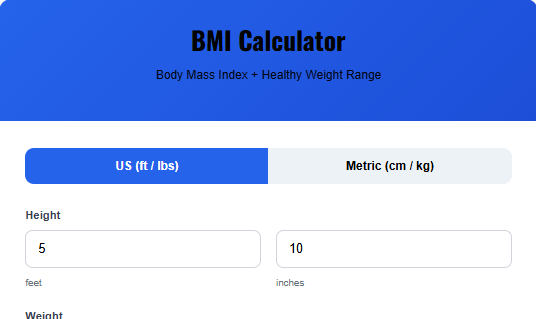


BMI Calculator
Body Mass Index + Healthy Weight Range
Healthy Weight Range for Your Height
BMI is a useful screening tool but does not directly measure body fat or account for muscle mass, age, or ethnicity. Always consult a doctor for personal health advice.
BMI is a useful starting point for most people—until muscle enters the picture.
If you’ve played with the BMI + Ideal Weight / Healthy Weight Range Calculator we put up on our subdomain General Dispatch, you’ve already seen the basic math: weight divided by height squared. For the average American who’s not training hard, that number gives a decent quick read on whether you’re carrying extra fat that raises long-term health risks. The standard categories from the CDC still hold for most folks:
- Under 18.5: underweight
- 18.5–24.9: healthy
- 25–29.9: overweight
- 30+: obese
Those cut-offs were built for population-level screening of sedentary and lightly active adults. They work reasonably well when higher weight mostly means higher body fat. That is not the case for people who lift seriously, compete in strength sports, or simply carry a lot of muscle.
Why muscular people get falsely labeled “fat”
Muscle is denser than fat. A pound of muscle takes up less space than a pound of fat, but it still registers the same on the scale. BMI only sees total weight relative to height. It has no way to tell the difference.
The result is predictable and well-documented. Collegiate strength athletes, NFL players, rugby forwards, powerlifters, and bodybuilders routinely land in the “overweight” or “obese” BMI range while carrying body-fat percentages that would make most people jealous. Studies have shown large shares of male strength athletes and NFL Combine participants classified as obese by BMI when actual body-fat measures put them in the athletic or healthy range. Professional bodybuilders in contest shape can post BMIs of 30–35+ with single-digit body fat. The scale and the BMI formula simply cannot distinguish lean mass from fat mass.
If you train hard, add muscle, and then check a standard BMI calculator, the number will often call you overweight or worse. That reading is not “correct” in any meaningful health sense. It is a limitation of the tool.
What muscular people should actually measure
When BMI no longer tracks with how you look, perform, or feel, shift to body composition. The most useful metrics are body-fat percentage and, for serious lifters, Fat-Free Mass Index (FFMI).
DEXA (or DXA) scan remains the practical gold standard for most athletes and dedicated trainees. It uses low-dose X-rays to separate fat mass, lean mass, and bone mineral content, often with regional breakdowns (arms, legs, trunk). Error is typically in the 1–2% range for body-fat percentage when done properly. Many sports performance centers and imaging clinics offer it.
Other solid options, ranked roughly by accuracy and practicality for people who train:
- Air-displacement plethysmography (Bod Pod) – good lab alternative to DEXA.
- Hydrostatic (underwater) weighing – classic two-compartment method, still accurate when available.
- Trained skinfold calipers – inexpensive and surprisingly useful for tracking changes over time if the same experienced tester does the measurements under consistent conditions.
- Multi-frequency bioelectrical impedance (higher-end devices) – better than cheap bathroom scales; still sensitive to hydration, so treat numbers as trends rather than absolute truth.
- Waist circumference and waist-to-height ratio – simple, free, and surprisingly informative for health risk. For most adults, a waist over 40 inches (men) or 35 inches (women) raises concern regardless of BMI. Keeping waist circumference under half your height is a solid practical target.
FFMI (fat-free mass divided by height squared) is especially useful for bodybuilders and strength athletes. It normalizes lean mass the way BMI normalizes total weight, so it better reflects muscular development relative to frame size. Natural male lifters often sit in the low-to-mid 20s; values approaching or exceeding ~25 at low body fat are uncommon without pharmacological help and serve as a rough genetic-ceiling reference for many trainees.
Practical takeaways for Whatfinger readers
- Use the BMI calculator for a quick population-level check if you’re not carrying significant muscle.
- If you lift regularly, look lean in the mirror, have a solid waist measurement, and still get an “overweight” or “obese” BMI, ignore the label. Get a body-fat measurement instead.
- Track trends under consistent conditions (same time of day, hydration, recent training status). Absolute numbers matter less than whether body fat is dropping or lean mass is rising while performance improves.
- Health risk is driven far more by excess fat (especially visceral fat around the organs) and metabolic markers than by a high BMI caused by muscle.
BMI is a screening tool, not a diagnosis. For the average person it is convenient and useful. For muscular people it is often misleading. Measure what actually matters—body composition—and stop letting a 19th-century height-and-weight formula tell you that you’re fat when the mirror, the tape measure, and your bloodwork say otherwise.
Stay strong.
— Michael Anthony: Health Editor at Whatfingr News
See Health Articles and Videos
- Michael Anthony Health at Choice
- Longevity Articles – Choice – Whatfinger News
- Michael Anthony Health Articles at Dedicated issues
References
- BMI for Athletes and Bodybuilders: Realistic Ranges
- Traditional BMI cut-offs overestimate overweight and obesity in male athletes
- Male athletes need higher BMI to define overweight or obesity
- Body mass index versus body fat percentage in athletes
- Come Back Skinfolds, All Is Forgiven: A Narrative Review of the Efficacy of Common Body Composition Methods in Applied Sports Practice
- Fat-Free Mass Index in Users and Nonusers of Anabolic-Androgenic Steroids (Kouri et al.)
- CDC: About Adult BMI
- Waist Circumference and Cardiometabolic Risk